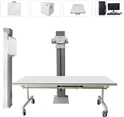


In 1895, the discovery of X-rays by German physicist Wilm Konrad Roentgen led to the emergence of new diagnostic tools used by doctors. A few months after he discovered X-rays, Russell Reynolds made this X-ray machine. This is one of the oldest X-ray machines in the world, allowing humans to view the interior of the human body without any incision.
Development History
Since 1895, X-ray diagnosis and treatment technology has made rapid progress, which can be divided into the following stages:
(1) Ion X-ray tube stage (1895-1912)
This is the early stage of X-ray equipment. At that time, the structure of the X-ray machine was very simple. The gas containing cold cathode ion X-ray tube with low efficiency was used to generate high voltage by using a bulky induction coil. The exposed high-voltage parts were not equipped with accurate control devices. The X-ray machine device has small capacity, low efficiency, weak penetration, low image clarity, and lack of protection. According to records, taking an X-ray pelvic image required an exposure time of 40-60 minutes. However, after the photo was taken, the subject's skin was burned by the X-ray.
(2) Electronic X-ray tube stage (1913-1928)
With the development of electromagnetism, high vacuum technology and other disciplines, in 1910, the American physicist W.D. Coolidge published a report on the successful manufacture of tungsten filament X-ray tubes. Since its practical use in 1913, its biggest feature is that the tungsten filament is heated to an incandescent state to provide the electrons required for the tube current. Therefore, adjusting the heating temperature of the filament can control the tube current, so that the tube voltage and current can be independently adjusted, which is precisely what is needed to improve image quality.
The invention of filter grids in 1913 partially eliminated scattered rays and improved the quality of images. In 1914, a cadmium tungstate fluorescent screen was produced, which began the application of X-ray fluoroscopy. In 1923, he invented the dual focus X-ray tube, which solved the need of radiography. The power of an X-ray tube can reach several thousand watts, and the side length of a rectangular focal point is only a few millimeters, greatly improving the quality of X-ray images. At the same time, the gradual application of contrast agents has continuously expanded the diagnostic range of X-ray. It is no longer a simple tool for simply capturing bone images, but has become an important medical diagnostic facility that can also examine the gastrointestinal tract, bronchi, blood vessels, ventricles, kidneys, bladder, and other natural contrasts (small X-ray absorption differences) in human tissues and organs. At the same time, X-rays have also begun to be applied in treatment.
Apr 29, 2023
The Inventor Of The X-ray Machine
Send Inquiry
Product Categories
Latest Products